

ON: Showtime!
The thrills and pitfalls of live performance

Song of the Week: “Everybody Scream,” by Florence + the Machine - “But look at me run myself ragged / Blood on the stage / But how can I leave you when you’re screaming my name?”
I was a freshman in university the first time I saw A Midsummer Night’s Dream. I had been to plays before - in fact, for my tenth birthday we saw an Old West-themed production of The Taming of the Shrew at the Stratford Festival - but never like this.
The play was an outing organized by the Honors program, and every aspect of it felt enormously glamorous, from dressing up with my friends to the thick cardstock of the tickets.
We were at the Chicago Shakespeare Theater, a theater that adheres to original performance practices in the shape of the venue (a “U” of seats surrounding a jutting stage) and the lack of microphones. Our seats were so close to the stage that I felt like I could reach out and touch the actors. And the production was sexy: from the 80s rockstar look of Fairy King Oberon, with his orange ballgown skirt, bare chest, and Bowie-esque hair and makeup, to the sensuality of the romance between the various couples in the play. I didn’t realize that theater could be sexy. It felt a little dangerous.
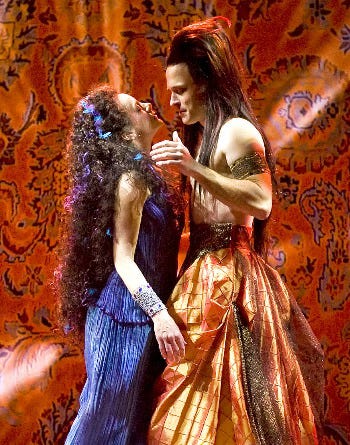
A month later, I had an opportunity I’ve never had before or since: I got to see the same cast in the same production again, this time with my fellow freshman English majors. I felt like a seasoned veteran as we pulled up to the theater for a second time, gleefully promising my friends that they would love the costumes and lighting effects. This time, I had a notebook and pen in hand; I had to quietly take notes for a paper about the show.
The play was the exact same, of course; but it also wasn’t. My seats were different. The pauses were different. The way I was looking - analytically, instead of in total wonder - was different.
A Midsummer Night’s Dream is a study in contrasts: true love versus lustful infatuation, prim society versus unruly wilderness, royalty versus salt-of-the-earth working people. It remains one of Shakespeare’s most popular plays today because it’s so accessible in its enchantments: there are sitcom-style misunderstandings, magic spells, and a whole sequence where a boorish guy’s head is transformed into that of a donkey and then a lot of people make jokes about him being an ass.
Midsummer is also a play - far more than, say, Macbeth or Much Ado About Nothing - that is very much about the ephemerality and enchantment of live performance. Its biggest laughs come at the expense of the “Rude Mechanicals,” a group of tradespeople who are rehearsing an amateur theatrical production for the upcoming wedding of the Duke of Athens.
The Rude Mechanicals are anxious that their audience will be terrified by the bloodshed and danger in their production, and will think it is real.1 So they insert careful disclaimers into their script, informing their audience (and by extension, us) that it’s all made up. As Nick Bottom (get it?) suggests during their big rehearsal:
Write me a prologue, and let the prologue seem to
 say we will do no harm with our swords and that
 Pyramus is not killed indeed. And, for the more
 better assurance, tell them that I, Pyramus, am not
 Pyramus, but Bottom the weaver. This will put them
 out of fear. (III.i.17-22)
Bottom and his fellow actors are intent on breaking the fourth wall: the invisible, imaginary wall that separates the actors from the audience, and the fiction from reality. While other forms of art like books, TV shows, and movies also have figurative fourth walls, they’re not as immediate as in theater.
In theater, the audience can see the performers - and the performers can see their audience. Whatever is going to happen is only going to happen once; it cannot be rewound, restarted, recreated. Live performance is ephemeral and immediate: a shimmering soap bubble that hangs in time for a moment before bursting.
I have seen Midsummer twice since that spring in Chicago. A year later, I dragged my parents on foot for sixteen blocks in sweltering July humidity to see a free production put on by Shakespeare in the Park. We didn’t have chairs or blankets to sit on, and the stage was too far away to really appreciate the action, but I’ll never forget the moment when the mischievous character Puck ran through the audience, stole a man’s sunglasses, and wore them for the rest of the play.
And I saw it once more last weekend, in an enchanting production performed by Theatre students at the University of Waterloo. In their version, young Hermia is queer, and her forbidden love is Lysandra, not Lysander. The gender swap was the only major change they made, but I was struck by the way that choice changed and refreshed the whole play for me, like a stone sending out ripples when thrown into a pond.
For the first few scenes - as is always the case when I’m watching a live show - I was on the edge of my seat, nervous for the performers, hoping desperately that they would remember their lines and nothing would go wrong.
But then, of course, the play worked its magic; we laughed at the fairies’ antics, gasped at dramatic transformations, and applauded when all was set right at the end. And then the lights went up, and the enchantment dissipated, and I was a thirty-something staff member sitting in an auditorium whispering “Those kids did such a good job” to my husband.
As Puck declares in the play’s closing monologue:
…you have but slumbered here
 While these visions did appear.
 And this weak and idle theme,
No more yielding but a dream… (V.i.442-5)
I was awake again. It was time to go home.
You Had to Be There
Of course, the magic of live performance isn’t limited to theater. If you’ve ever felt your heart in your throat as acrobats flew through the air at Cirque du Soleil, or cried laughing at an improv show, you know the feeling that I’m talking about: like anything could happen.
Even sports, though unscripted, carry the same drama, the same surprise: on a recent podcast episode, John Green called soccer games a theater performance where none of the actors know the ending.2
And there’s a reason why, despite excellent concert movies and studio recordings being easy to find, people still make huge sacrifices and pay hundreds or thousands of dollars to see their favorite musicians live. It’s not just about bragging rights and Instagram clout (though of course, that may be part of it); I think it’s for the opportunity to exist in the same place and time, if only for a few hours. To feel like the music itself is white-hot electricity arcing between you and the performer.
The first time I saw a band live was when a friend gave me a spare ticket to see Christian alternative rock act Gungor in university. We were in the very back row on the balcony in the performing arts center, a venue that usually saw concertos and symphonies. I only knew one Gungor song, and I had no idea what to expect.
Suddenly, the whole room went dark; tense strings played softly, and a woman’s voice began to sing, with imagery borrowed from the Biblical book of Genesis. Gradually, the music swelled as she repeated again and again: “let there be…let there be…let there be…light.”
And suddenly:
Blazing light filling the auditorium, a triumphant crash of sound, the band on the stage going wild, and I was on my feet, I was screaming, and it felt like every other staid, conservative kid in that auditorium was on their feet screaming too.
It changed my life.3
I felt it again, a year later, when I saw The Head and the Heart live in Chicago and I cried and swayed to “Rivers and Roads” with my best friend. I felt it dancing to the Lumineers in the Colorado sunshine. I felt it jumping up and down with a crowd of sweaty strangers a year into Trump’s first presidency, as The Mountain Goats defiantly yelled: I am going to make it through this year if it kills me.
I’m not doing it justice; you had to be there.
I’m sure there’s a show out there that you wish beyond wish you could have been to, but you missed out. Maybe it’s where you would go, if you had a time machine and no major ambition to change history. The Eras Tour, a couple summers ago? The Beatles’ spontaneous final concert, on a London rooftop in 1969?
For me, that show is Lilith Fair.
As Lilith Fair: Building a Mystery (2025) documents, Lilith Fair transformed the music scene both for female artists and their fans.4 A massive touring festival consisting of exclusively female musicians that ran from 1997 to 1999, Lilith Fair was created by Sarah McLachlan to address the pervasive sexism in the music industry. Female artists were belittled, tokenized, and seen as a liability. Radio jockeys wouldn’t even play songs by female artists back-to-back. After touring with Paula Cole and proving that two female artists on the same bill could sell tickets, McLachlan created the festival.
It was widely mocked by pop culture as a hippie lesbian love fest, but it was successful by every metric: it had the largest audiences and most performances of any festival in the 1990s. It helped launch the careers of artists like Cristina Aguilera, Jewel, Nelly Furtado, and Tegan and Sara, and propelled more established musicians up the charts. With lineups that featured artists as diverse as Queen Latifah and Sheryl Crow on the same night, it built friendships and alliances among women across the music industry.
And it was incredibly meaningful for audiences as well: most of them women and queer people who had never been in spaces where they could feel completely safe and at ease.
One of the headliners all three years of Lilith Fair was the Indigo Girls: a proudly lesbian folk-rock duo whose outspoken activism often left them marginalized. The organizers of Lilith Fair fully embraced them and treated them as equals, making the festival a space to advocate for LGBTQ+ rights as well as reproductive rights, civil rights, and the environment.5
In the documentary, prominent LGBTQ+ celebrities including Brandi Carlile and Dan Levy talk about how transformative a space like Lilith Fair was for their development; not just because of the representation they found in the music, but also because the entire festival felt like an alternative universe where they could be loved and accepted.
“Being there was one of the earliest memories I’ve had of safety,” Levy recalls. “I was 12 or 13 at the time and still in the closet and had been bullied and never really felt safe anywhere that I was because I wasn’t being myself. But when you look around and you see people smiling and laughing and holding on to each other, and you just had people who were seeing themselves, celebrating themselves, it felt like this kind of quiet revolution.”
Break a Leg
The magic of live performance stems from its wildness, its fragility. Anything could happen. An actor could forget her lines. A musician could play a brand new song, or get into a fistfight with the drummer. An acrobat could fall and break every bone in their body.
That sense of risk is what makes it so powerful, and so exciting; but it can also have devastating consequences.
In one of the most beloved This American Life episodes of all time, “Fiasco!” (1997), writer Jack Hitt tells the story of his teenage attendance at a doomed small town production of Peter Pan that flew awkwardly from disaster to disaster.
Directed by a woman with no theater experience, and produced by a crew that didn’t have the technical know-how to properly execute the special effects, the show was one in which “There was certainly a sort of air of everyone reaching beyond their own grasp,” Hitt recalls, “Every actor was sort of in a role that was just a little too big for them. Every aspect of the set and the crew…”
The show began poorly, with the flying harnesses malfunctioning and jerking the child actors around the stage like marionettes. But at this point, Hitt says, the audience was still on their side. “One of the great things about audiences, especially in a live theater production, is that they’re very forgiving. They want the show to work. And so everyone is sort of gripping their chair a little tightly. We feel for them. They’re up there. They’re embarrassing themselves for us.”
But then, like a series of cascading dominoes, more and more elements of the show went haywire. I won’t spoil the specifics - it really is a hilarious story worth listening to - but it culminated in members of the audience standing, laughing out loud, and chanting for more disaster as the local volunteer fire department rushed to the scene.
“See, I think the old theater critics, the ancients, would say that the reason you go to the theater to see a great production is to be, I think the word they used to use is ‘transported,’” Hitt concludes. “The idea being that you would be lifted away from your animal nature and into these higher, more spiritual realms, or get in touch with these greater, tragic emotions, right? But of course, what happened here was the exact opposite. We got transported directly in touch with our animal being.”
The irony, Ira Glass points out, is that situations where things go wrong, where people have to push themselves past their limits, don’t always lead to fiascos. Sometimes they are just what leads to greatness.
For the last couple of weeks, I have been obsessed with the musician Jon Batiste and his wife, writer and artist Suleika Jaouad. Most people are familiar with Batiste because he was the band leader on the Late Show with Stephen Colbert for eight years, or because he won Album of the Year at the 2022 Grammys.
Jaouad, meanwhile, is known for her memoir Between Two Kingdoms, which reflects on her leukemia diagnosis at age 22, and how she decided to live once she went into remission.
I, however, stumbled across the couple’s immensely charming home tour on the Architectural Digest YouTube channel, and immediately fell in love.
The tour features thrifted and homemade art and furniture, pianos in every room, and a Grammy award kept in the bathroom. It also includes references to the couple’s wedding, which happened in their unfinished living room the day before Jaouad was admitted to the hospital for a second bone marrow transplant after the cancer returned in her thirties.
From there, I read a profile of Jaouad in the Atlantic, watched interviews by Stephen Colbert with both of them, and subscribed to her Substack. And finally, last night, I watched the 2023 documentary American Symphony, which follows Batiste composing a symphony for performance at Carnegie Hall while Jaouad endures gruelling treatment.
American Symphony was originally intended to be a straightforward concert documentary: it would follow Batiste across the country as he built relationships with musicians and composed music that brought together numerous American musical traditions in an innovative and subversive way. Then several earth-shattering events forced Batiste and the filmmakers off course: first, the Covid-19 pandemic; then, the return of Jaouad’s cancer a decade after her first diagnosis.
As both of the film’s subjects emphasize, the months documented by the filmmakers are both incredibly exciting and incredibly difficult: Jaouad has her first round of chemo the day that Batiste’s eleven Grammy nominations are announced. Throughout the film, Batiste moves from his wife’s hospital bed to studios and rehearsal rooms to glamorous awards shows and stadiums. Jaouad paints strange, dreamlike visions from her hospital room, and Batiste composes lullabies for her to listen to when she’s in isolation.
“We both see survival as its own kind of creative act,” Jaouad remarks.
Batiste dances with her in the corridors, then has panic attacks in the hospital courtyard. He brings down the house at the Grammys, then lies in bed talking to his therapist about his deepest fears of failure and loss. He’s terrified that he’ll break under the pressure.
The climax of the film, of course, is the performance of “American Symphony” at Carnegie Hall. Jaouad’s second marrow transplant was successful, and she is once again in remission. She watches, masked and turbaned, from a balcony as her husband takes the stage.
He leads the first act of the symphony, which incorporates the hymn and spiritual traditions, Indigenous drumming, and electronic instruments alongside the traditional orchestra instruments. Then, just as he begins the second act, something goes terribly wrong.
We see musicians’ eyes widen, hear frantic whispers: the power is out, but only on the stage. The microphones, electronic instruments, earpieces - none of them work - but the audience can’t tell anything has happened.
Batiste stares into space for a moment, shocked. Then he shakes his head slightly, almost to himself, and smiles. He’s a New Orleans jazz musician since birth. He’s got this. Barely missing a beat, he begins to play the piano, and improvises a solo piece until the power is restored.
And then the symphony carries on, the audience none the wiser.
“You’ve got to confront the brutal facts of the reality that you might not pull it off,” Batiste reflects while composing earlier in the film. “But at the same time have unwavering faith, completely unwavering faith. And you have to do both at the same time.”
When it comes to showtime, what should I add to my syllabus?
I want to hear from you, whether it’s in the comments on this post or in emails to me directly at roschmansyllabus@substack.com!
This is never a legitimate concern, because the Rude Mechanicals are terrible actors.
Or something like that. I couldn’t find the quote, you guys, and I consume so much content from John Green that it was pretty difficult to track down.
You can see a recording of Gungor’s opener at nearby Calvin College here, but it really doesn’t capture what it felt like. That’s the whole point, of course.
If you’re in Canada, you can watch the whole documentary for free on YouTube here. I believe in the States it’s available on Hulu. I saw it at a screening last week at my local independent theater, the Princess!
They also hired a large number of female crew members, and were the first tour to give employees extended health benefits.
I will never forget the first time I watched a live performance of Peter Pan (play or musical, my memory is fuzzy on that), I was maybe around 6 years old. I was incredibly infatuated by the performance and bordering on obsession, so naturally, when I went home, I tried to re-enact the scenes.