

ON: Memorials
How we commemorate the ones we loved…or didn’t.

Song of the Week: “If I Die Young,” by The Band Perry - “Send me away with the words of a love song”
[Content warning: This syllabus is about death, and includes a picture of human bones]
Like so many others, the highlight of my last week and a half has been the live footage of the Artemis II mission to the Moon and back. I’ve dug deep into the meaning behind Canadian astronaut Jeremy Hansen’s Indigenous-designed mission patch, listened to Victor Glover’s poignant Easter message of love and ecological preservation, and enjoyed the memes, jokes, and simple human moments that have naturally emerged from collectively watching four incredible humans spend ten days flying through space in a ship roughly the size of a van.
Without a doubt, however, my favorite moment in the Artemis II mission occurred on April 6, during the crew’s lunar observation period. In a call with Mission Control, Hansen requested that they be allowed to name two points of interest on the Moon’s service. The first, “Integrity,” would be named for their spacecraft.
As he delivered the second request, however, Hansen became choked up: no small thing for famously stoic astronauts. “A number of years ago, we started this journey in our close-knit astronaut family,” he said, “and we lost a loved one…her name was Carroll, the spouse of Reid, the mother of Katie and Ellie.”
In the background, Captain Reid Wiseman visibly wiped away tears, then clasped Hansen’s shoulder with his hand. After Hansen finished his message, all four astronauts held each other in a zero-gravity group hug, and observed almost a full minute of silence before Mission Control acknowledged, “Integrity and Carroll craters, loud and clear. Thank you.”
Cpt. Wiseman’s wife, Carroll Taylor Wiseman, was a neonatal intensive care nurse who died of cancer in 2020 at the age of 46. “Despite a long list of professional accolades,” NASA said in a statement, “Reid considers his time as an only parent as his greatest challenge and the most rewarding phase of his life.”

“Dear Carroll: you were truly loved to the moon and back,” reads the top-voted comment on a reel about Carroll from NASA’s Instagram page. “And now we all are witnesses to your love story, forever.”
Monuments
I’ve been thinking a lot, recently, about the memorials we create for the dead - moon craters and museums, scholarships and statues. In Ancient Egypt, the Pharaohs spent most of their adult lives building splendid tombs to hold them in death, and these tombs remain the most recognizable symbol of their kingdoms.
Most leaders, however, are commemorated only after they have died, as in the case of U. S. President Abraham Lincoln’s iconic Lincoln Memorial. Shortly after Lincoln’s assassination in 1865, politicians and members of the public alike demanded he be memorialized. The first of these memorials, a statue by Lot Flannery, was erected in 1868, in front of the D.C. City Hall. A year earlier, Congress had passed a bill commissioning a grand memorial for the president. This vision wouldn’t be realized, however, until 1914, when construction finally began on the enormous statue and encompassing building that still stand today.
The grand opening in 1922 was attended by Lincoln’s only surviving son, 78-year-old Robert Todd Lincoln, as well as many prominent Black Americans. When they arrived at the ceremony, however, the Black attendees discovered they had been assigned a segregated section from which to watch the proceedings.
Forty-one years later, during the March on Washington, Martin Luther King Jr. stood on the steps of the Lincoln Memorial before a crowd of more than 250,000 people and delivered his “I Have a Dream” speech.
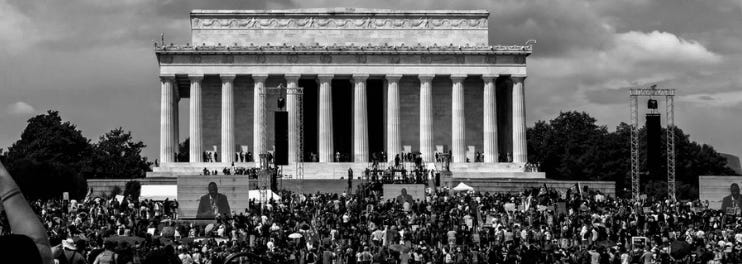
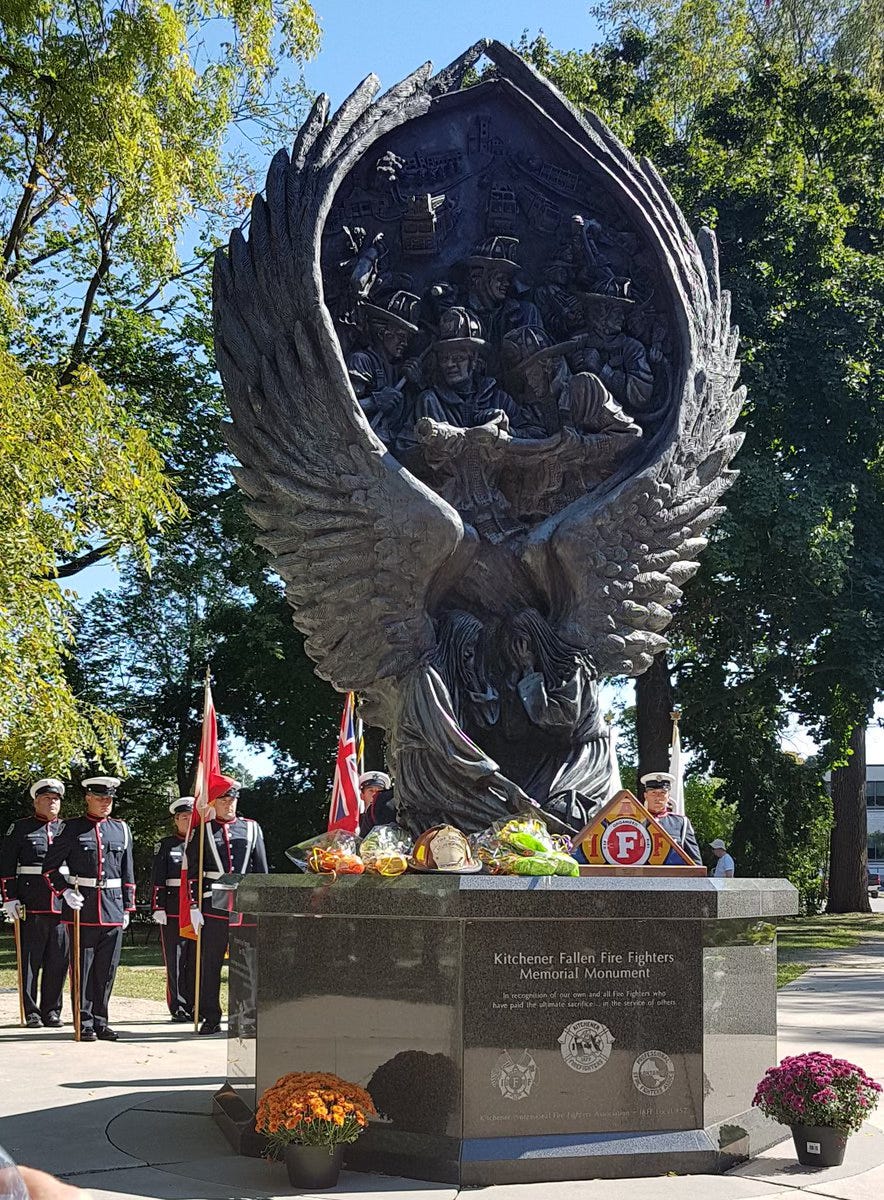
Most people, of course, are not famous enough to receive dedicated memorials upon their deaths, unless they die in a way that is perceived as particularly heroic. The Lincoln Memorial is one of many memorials in Washington D. C., including the eerie Vietnam Veterans Memorial, which features two slabs of black granite engraved with the names of the American soldiers who died or remain missing in the Vietnam War. Most small towns in the United States and Canada contain memorials for casualties and veterans of World War I and World War II, and I have been to more than one Tomb of the Unknown Soldier as well. And not all monuments celebrate soldiers: just down the street from my beloved public library, there is a dramatic statue honoring local firefighters who have died while on duty.
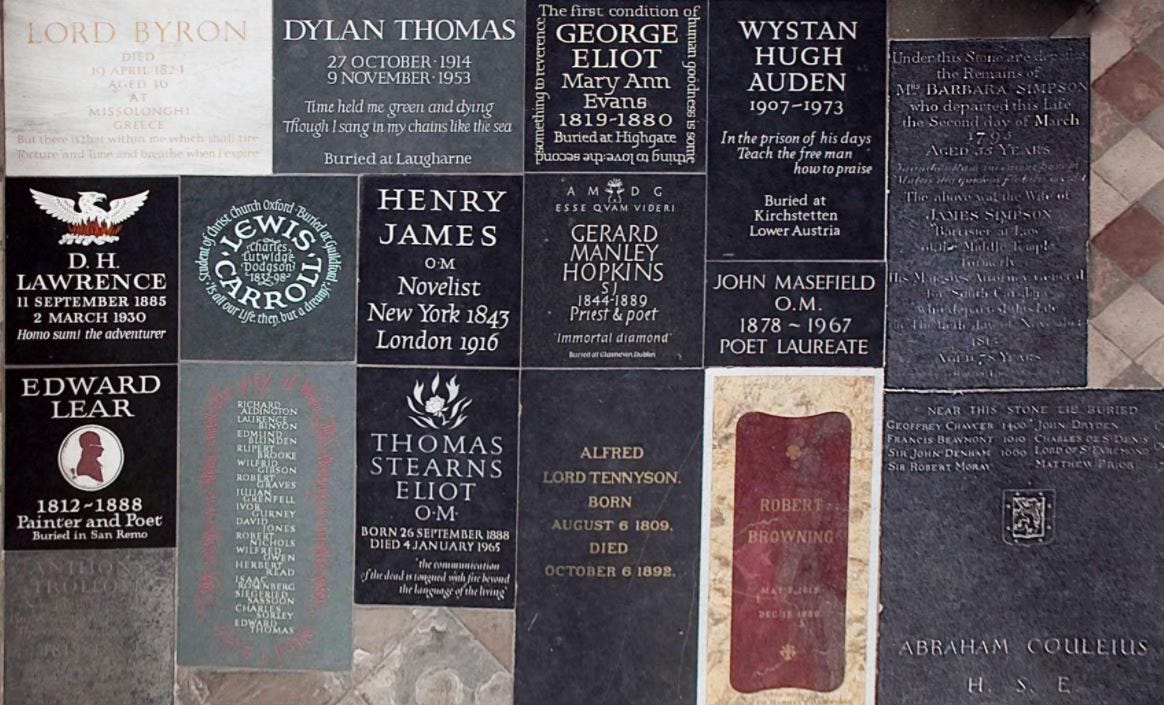
Elsewhere, the accumulated number of memorial statues, stones, and engravings can be so dense it’s almost comical. When I first visited Westminster Abbey in London, I marveled at how I couldn’t take a step without encountering a famous historical figure: more than 3,000 people are buried or commemorated there. One moment, I was standing next to the elaborately carved tomb of Queen Elizabeth I. A few minutes later, I was mere inches away from Isaac Newton’s bones.
“Poet’s Corner,” meanwhile, commemorates an astounding number of British writers. It began when Geoffrey Chaucer was buried in the Abbey in 1400; his body was soon joined by those of George Frederic Handel, Charles Dickens, and Rudyard Kipling. In addition to the writers and artists actually buried at Poet’s Corner, there are busts, engraved stones, and stained glass window panels commemorating creators including William Shakespeare, Jane Austen, all three Brontë sisters, Oscar Wilde, and C. S. Lewis.
Many of those poets, of course, are buried elsewhere: in their local churches, entombed in grand family mausoleums, or beneath simple gravestones, often next to their beloved but far less famous spouses. Most people in Western countries are buried in similar cemeteries, with carved headstones recording their names, dates of birth and death, and occasionally brief messages or descriptions.
Our modern cemeteries are the descendents of medieval churchyards, where parishioners - whether rich or poor - were buried on hallowed ground. The wealthy, of course, commemorated their loved ones with elaborate memorials, whereas poor mourners often used wooden crosses that would rot away within years.
In urban areas, however, when churchyards became too crowded - or deaths happened too quickly - authorities had to come up with other solutions. In the neighboring town of Cambridge (formerly called Galt), generations of citizens were buried in the churchyard of St. Andrews Presbyterian Church. When the members of St. Andrews decided to move and join another church across town, however, they were left with a dilemma: what to do with the graves?
The city placed notices in local papers informing surviving relatives that they were responsible for exhuming their relatives and moving them elsewhere within a short timeframe; understandably, people were reluctant to do so, and many people either couldn’t afford to move their relatives or simply refused. Further complicating matters, existing maps of the buried bodies turned out to be incomplete and inaccurate: a deadly cholera outbreak some years before had forced citizens to bury bodies quickly, without prioritizing record-keeping.
The city could not sell or redevelop land containing unidentified human bodies, and so they decided to turn it into a park. The church was demolished in 1899, and in 1907 the Waterloo chapter of the Imperial Order of the Daughters of the Empire used the gravestones to construct Pioneer Pergola.

This unusual structure is built from the gravestones of 207 former residents of Galt, who died between 1835 and 1873. You can still visit it today and read their names, as Taylor and I did during a historical tour last Halloween.
Major cities, however, have faced far more pressing issues with overcrowding in cemeteries, and have found much more ghoulish solutions. I’ll never forget the hour Taylor and I spent wandering the labyrinthine Paris Catacombs, where millions of people’s bones are arranged in a bizarre architecture. The Catacombs began out of necessity, when the Les Innocents urban cemetery began to crush neighboring buildings through the sheer weight of the bodies buried within it: more than two million over six hundred years.
Fortunately, Paris was already crisscrossed by a series of former mines as well as masonry inspection tunnels, and so in 1785 wagons shrouded in black fabric began carting the dead from Les Innocents to the tunnels. Over the years, several other urban cemeteries also gave up their dead, including several mass graves of Plague victims. In total, between 5 and 6 million people are buried in the Catacombs: more than double the current living population of Paris.
At first, the bodies were stacked haphazardly in the mines wherever they would fit. In 1810, however, Louis-Étienne Héricart de Thury, director of the Paris Mine Inspection Service, decided to get…creative and turn the Catacombs into a bizarre hybrid memorial and tourist attraction.
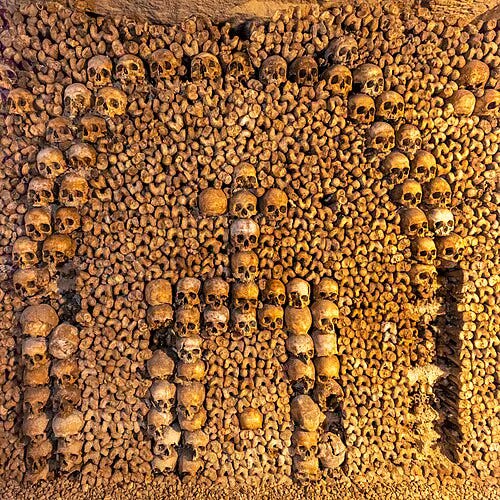
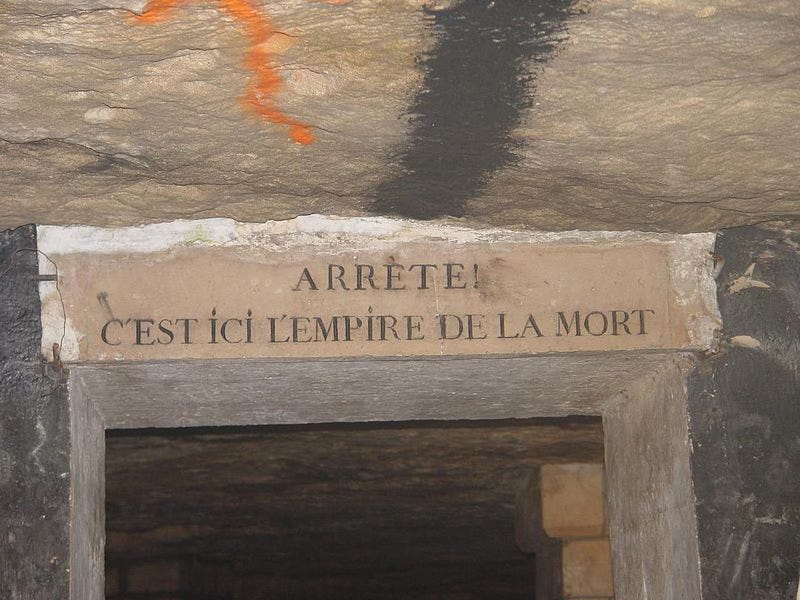
He had the bones stacked carefully into shapes and patterns, as well as displaying selected memorial stones salvaged from the original graveyards. He also put up arches and signs with ominous warnings, such as the one Taylor and I walked through as we began our journey, which reads: “Arrète! C’est ici l’empire de la mort.”
In English, “Stop! This is the empire of the dead.”
I left the Catacombs that afternoon feeling a strange mixture of dread, peace, and disassociation. It also confirmed my conviction that I do not believe in ghosts: if they existed, the air would be unbreathably thick with them.
As you climb the stairs out of the Paris Catacombs, you’ll encounter a variety of contemporary graffiti scrawled in Sharpie on white-washed bricks. “JJ was here,” reads one message. “Half-baked fruitcake,” another person has written, below what appears to be a doodle of a chicken. Normally I’d be annoyed by this defacement of a public site, but I can’t help but feel a warmth towards the people who left these messages. “JJ is alive,” they seem to say, defiant. “JJ is not bones yet.” Whistling in the dark.
While most modern cities have not had to resort to catacombs yet, burial of the dead remains a concern. Modern burial practices are both costly and ecologically destructive, and many people are questioning whether there might be more sustainable long-term solutions for human burial. The town of Colma, California, on the other hand, has embraced this problem.
Colma is possibly the only true necropolis in the United States. As an episode of the podcast 99% Invisible explains, the small town located roughly ten miles outside of San Francisco is home to seventeen human cemeteries and one pet cemetery, a full 73% of the town’s land. More than 1.5 million people are buried in Colma, though only 1,600 people live there. The town’s cheerful motto? “It’s great to be alive in Colma.”
In 1900, as the population of San Francisco boomed, city officials declared that no new burials could take place within the city limits. In response, churches and private associations began buying up land in a peaceful area south of the city - an area that eventually became the town of Colma.
Maureen O’Connor, President of the Colma Historical Association, loves living among the dead. She finds it quiet and contemplative. “I look out on the cemeteries and I think, ‘These people are resting in peace,’ and sometimes I feel overwhelmed by all the things that I have to do, but the day that I wake up that I don’t have anything to do, I’m probably going to be moving into a cemetery.”
Though I hope to see many more decades before I die, I love visiting cemeteries. I love reading the strange names, speculating about family relationships, and chuckling over funny epitaphs like “I told you I was sick.” And I think there is some value in each of us taking a moment to consider what we would like our loved ones to do with our bodies when we are gone.
Me? I want to be cremated and turned into a tree.
Thy Book Doth Live
I find Poet’s Corner particularly interesting because, from a certain perspective, it feels entirely superfluous. Of all the people buried in Westminster Abbey, the poets have the least need for marble busts and engraved granite stones. Any time Handel’s “Messiah” is performed, or an actor walks the stage reciting “To be, or not to be,” they are remembered.
Poet’s Corner reminds me that, while a select few are commemorated with buildings and statues, most of us are commemorated primarily through words. Even before obituaries and eulogies became a common part of everyday life, poets wrote verses about beloved friends and public figures.
Shakespeare’s bust in Westminster Abbey wasn’t erected until 1740; more than a century before, the poet Ben Jonson wrote a poem, “To the Memory of My Beloved the Author, Mr. William Shakespeare,” to open the 1623 First Folio. “Thou art a monument without a tomb, / And art alive still while thy book doth live / And we have wits to read and praise to give,” Jonson writes.
Walt Whitman’s “When Lilacs Last in the Dooryard Bloom’d,” meanwhile, spends 206 lines mourning the death of Abraham Lincoln without once calling him by name. Instead, Whitman employs the classical form of the pastoral elegy, using a series of natural images to obliquely mourn the president: “O powerful, western, fallen star! / O shades of night! O moody, tearful night! / O great star disappear’d! O the black murk that hides the star!”
My favorite elegy, however, is undoubtedly W. H. Auden’s 1940 poem “Funeral Blues.” Originally written for a play, the poem saw renewed popularity during the AIDS epidemic. In Richard Curtis’s Four Weddings and a Funeral (1994), a bereaved man reads it at his lover’s funeral.1
Stop all the clocks, cut off the telephone,
Prevent the dog from barking with a juicy bone,
Silence the pianos and with muffled drum
Bring out the coffin, let the mourners come.

Let aeroplanes circle moaning overhead
Scribbling on the sky the message 'He is Dead'.
Put crepe bows round the white necks of the public doves,
Let the traffic policemen wear black cotton gloves.

He was my North, my South, my East and West,
My working week and my Sunday rest,
My noon, my midnight, my talk, my song;
I thought that love would last forever: I was wrong.

The stars are not wanted now; put out every one,
Pack up the moon and dismantle the sun,
Pour away the ocean and sweep up the wood;
For nothing now can ever come to any good.
Beyond funerary poems, innumerable authors have written books either explicitly or implicitly honoring fallen friends and loved ones. When Katherine Paterson’s son’s best friend was killed in a freak accident at the age of 8, she was inspired to write the heartbreaking children’s classic Bridge to Terabithia (1977). I have written before about Ella Risbridger’s hybrid cookbook/memoir Midnight Chicken & Other Recipes Worth Living For (2019), which is dedicated to her partner who died of cancer in his twenties shortly before its publication. And Toni Morrison’s Pulitzer Prize-winning Beloved (1987), which is inspired by the life of Margaret Garner, has a simple epigraph: “Sixty million and more.” It is dedicated to all those who died as a result of the Transatlantic Slave Trade.
John Green’s first novel, Looking for Alaska (2005), is inspired by one of John’s classmates who died suddenly when he was in high school. The novel’s protagonist, Miles Halter, collects a different kind of memorial: famous last words. When one of Miles’s friends dies suddenly in a tragic accident, however, Miles becomes obsessed with the ambiguity and suddenness of her death: he doesn’t know why she died, or what she felt, or what her last thoughts or words were. Ultimately, he must make peace with the sense of the unfinished that accompanies all loss, and learn how to keep living in her absence.
“Thomas Edison’s last words were “It’s very beautiful over there,” he concludes. “I don’t know where there is, but I believe it’s somewhere, and I hope it’s beautiful.”
In Loving Memory
In my job as a Communications Officer at the University of Waterloo, I write a lot of things: speeches, press releases about research, educational video scripts, and news articles about grants and awards. I am somewhat embarrassed to admit, however, that one of my favorite tasks is writing In Memoriams.2
In the 3.5 years since I began working at the university, a handful of elderly retired Math professors have died, and their former colleagues have requested that the university commemorate their deaths on its website. It is my job to collect memories from their friends and students, read the obituaries shared by their families, and sift through the archives for photos of them graduating, writing eagerly on chalkboards, and socializing at conferences. It’s always an honor to play this small part in narrating the lives of these brilliant and interesting men, and learning about their hobbies, accomplishments, and adventures.3
Each In Memoriam I write is also an excuse to indulge in one of my occasional hobbies: reading obituaries. Thus far, every Waterloo professor I have commemorated has been cared for by Erb & Good Funeral Home, an upscale local funeral home that features long and detailed obituaries for the people in its care. Whenever I am working on an In Memoriam, I pause and read through the last several pages of these obituaries. Some people have lived extraordinary lives: surviving prisoner-of-war camps, meeting Gandhi or the Queen, making groundbreaking scientific discoveries. Others’ life sketches are spent on their hobbies, their volunteer work, the inside jokes they shared with their grandchildren. I scratch my head at the focus of some - one woman loved Elvis so much that her obituary included both a picture of him and a quote from “Love Me Tender” - and marvel at the quiet pain and resilience in others, such as that of a woman who lost a daughter to childhood illness and then spent decades advocating for refugee children.
Obituaries, as I experience them on the funeral home website, are a relatively modern phenomenon.4 In the 18th century, as literacy became widespread, newspapers began printing death notices. Since each individual letter had to be laid out by hand, and the death notices were printed for free, these were usually quite brief: often just a person’s name, the statement “died,” and a date of death. If someone was particularly important - or, presumably, the news was slow that day - these death notices would occasionally also list a cause of death and surviving family members.
The Victorians were famously obsessed with death: they kept deceased loved ones’ hair in lockets, and often took photos with the corpses of family members who had recently died. It should come as no surprise, then, that they expanded obituaries greatly. In the United States, the Civil War was also a factor: death notices were incredibly important to inform people of soldiers’ deaths, and expanded coverage of deaths served as a form of honoring the sacrifice of the fallen.
The invention of linotype machines in the 1870s made typing and printing much faster, and enterprising newspaper editors decided to start monetizing obituaries accordingly. From this point forward, obituaries charged families by the word, and families in turn demonstrated their love and devotion by publishing detailed obituaries. It was during this period that the familiar genre of the obituary developed, with its four parts: announcement of death, brief biography, surviving family, and funeral arrangements.5 Over the following decades, obituaries exploded in popularity; by the 1930s, one half of all newspaper pages printed in the United States were dedicated to obituaries.
For the last century, most major newspapers have published obituaries in this style for famous or notable figures. Most publications also keep on hand hundreds of pre-written obituaries for famous figures, so that they can go to press quickly upon news of their death. Sometimes, these pre-written obituaries sit around for so long that their original authors die before their subjects do. New York Times reporter Michael T. Kaufman, for example, died in 2010, almost fourteen years before the obituary he wrote for Henry Kissinger was finally published.6
Occasionally, the obituary of an ordinary person reaches as many readers as a famous person, usually because of the style of the writing. That was the case for Kathleen Dehmlow, whose 2018 obituary appeared in a small-town Minnesota newspaper. Though the obituary begins with the ordinary biographical details, it soon veers into the blunt and angry, detailing how Kathleen abandoned her husband and children for another man. “She passed away on May 31, 2018 in Springfield and will now face judgement. She will not be missed by Gina and Jay, and they understand that this world is a better place without her.”
On the other end of the spectrum - much like the dead on those war memorials - other ordinary people’s obituaries become famous because of the historical moment in which they died. To me, one of the most indelible images of the Covid-19 pandemic is the May 24, 2020 cover of The New York Times.
“U. S. Deaths Near 100,000, an Incalculable Loss,” reads the headline. The subheader, “They were not simply names on a list. They were us.”
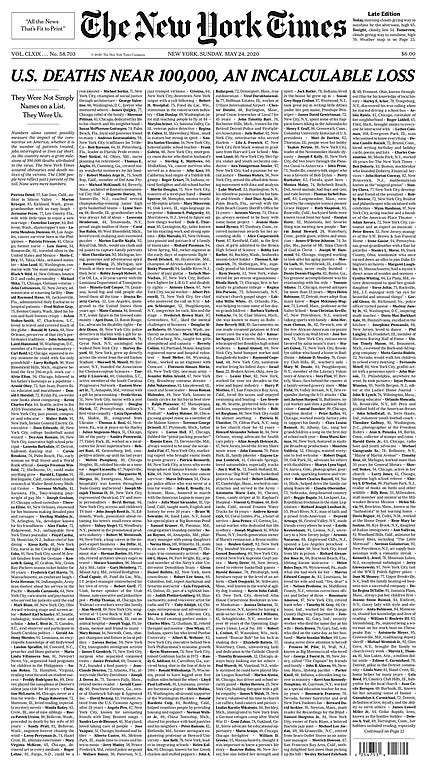
The tiny, dense columns of text that follow contain the names of 1,000 of the Americans who had died from Covid-19 in the first two months of the pandemic, along with single lines carefully selected by reporters from obituaries published across the country. I will always remember one tiny obituary that I managed to read before I became too overwhelmed to go on: “Fred Walter Gray, 75, Benton County, Wash. Liked his bacon and hash browns crispy.” Such an inconsequential yet deeply human detail, summing up a whole life.
In a 2019 interview on The Late Show, Stephen Colbert asked actor Keanu Reeves what he thinks happens after we die. Reeves is no stranger to loss; in 1999, his daughter was stillborn, and in 2001, his partner Jennifer Syme was killed in a car crash.
In the clip, Reeves sits back, considering Colbert’s question, and takes a deep breath. “I know the ones who love us will miss us,” he concludes.
At their best, after all, whether written in a small town newspaper or the surface of the moon, memorials all say the same things, again and again and again:
We love you. We miss you. We remember.
When it comes to memorials, what should I add to my syllabus?
I want to hear from you, whether it’s in the comments on this post or in emails to me directly at roschmansyllabus@substack.com!
I should note that, while the character in the film is gay, he dies of a heart attack, not AIDS.
Latin for “in memory of.”
Thus far, it has exclusively been men. Math is, and historically has been, an overwhelmingly male-dominated field.
This section is mainly sourced from the episode “Short Stuff: Obituaries” of the podcast “Stuff You Should Know.”
This era of obituaries is also extremely useful for genealogists, since they establish relationships as well as maiden names.
Kissinger, a horrific and unrepentant war criminal, lived to the ripe old age of 100. One of the great injustices of being human, it seems, is that good people so often die young while the evil enjoy old age.