

ON: Conspiracy Theories
What are THEY hiding from you???

Song of the Week: “Violet Hill,” by Coldplay - “The future’s architectured / By a carnival of idiots on show”
For the last four months, I’ve been working with a retired sociologist named Ronald Lawson to turn his life’s work into an academic book. Lawson has spent the last forty years traveling around the world interviewing Seventh-day Adventists, and has collected an enormous amount of supplementary material that I have the alternate joy and chore of sorting through.
Most recently, I drafted a chapter on Adventism’s relationship with other religions, and was reminded of how intense some Adventists can be in their paranoia regarding Catholics. Within North America, at least, the church can be thought of as having two major “flavors” of member: those who are more focused on healthcare and education (the context I grew up in), and those who are more concerned with the imminent end of the world and corresponding persecution of Sabbath-worshipping Adventists.
For that second group, Rome and the Pope are and always have been public enemy number one. Traditional Adventists believe that the Catholic church will play a pivotal role in end times persecution, and in the meantime they have come up with a deliciously silly collection of urban legends and conspiracy theories to support that belief.
I vividly remember my pastor father having to put together a seminar to reassure people that no, Dan Brown’s blockbuster thriller The Da Vinci Code (2003) was not factual, and no, there wasn’t any evidence of a vast Catholic conspiracy of shadowy, murderous monks pulling strings behind the scenes.
In one often-repeated urban legend that showed up in Lawson’s archives, an Adventist pastor tours a beautiful Catholic cathedral, takes a wrong turn that separates him from the rest of his tour group, and accidentally ends up in a hidden room filled with weapons and other nasty-looking torture devices. “What are these for?” he nervously asks the priest who comes to retrieve him. “This is what we’ll be using on your people soon,” the priest replies, grinning wickedly.
In general, whenever conservative Adventists disapprove of a public figure or institution within the church, they’ll accuse them of being secret agents of Rome, or Jesuits in disguise. My favorite conspiracy theory from Lawson’s archives is a 1990s rumour that Jesuits infiltrated a number of church potlucks and poisoned the casseroles. When General Conference leaders were hospitalized in the aftermath, the Jesuits killed them, surgically stole their faces, and stepped into their lives and church leadership roles as undetected imposters.
One can only assume that, despite the Adventist condemnation of movie theaters, some members saw the 1997 Nicholas Cage thriller Face/Off and decided to write their own religiously inflected fan fiction.
Unfortunately for those Adventists who argue the church is unique among Christian denominations, Adventists did not invent anti-Catholic conspiracy theories. In fact, during the period that Adventism was founded - the 1830s and 1840s - anti-Catholic sentiment was rampant in the United States.
This was driven, as so much paranoia often is, by anxieties around immigration: the nineteenth century saw the Catholic population in the United States increase from 35,000 in 1792 to 10 million in 1900. Racist rumors and cartoons depicted immigrants from majority-Catholic countries like Italy, Ireland, and Poland as dirty, prolific, irrational, and antithetical to the American way of life.
In 1836, the best selling book of the year was Awful Disclosures of Maria Monk (alternately The Hidden Secrets of a Nun’s Life in a Convent Exposed), which claimed to be the true account of an ex-nun who had fled a convent ruled by tyrannical priests who snuck in via secret tunnel. In this convent, she claimed, nuns were raped and impregnated then their babies were baptized and murdered immediately after birth to expedite their journeys to heaven.1

Though Maria’s account borrowed heavily from the imagery of the Gothic novels that had been popular in the previous century, the public believed her absolutely, demanding an investigation into the convent where she claimed to have lived. Ultimately, a Protestant newspaper editor from New York City investigated her account and found several inaccuracies and falsehoods in her descriptions of the convent. He also discovered that Maria had suffered a brain injury as a child, and lived in an asylum for several years. Whether she truly believed her story or was intentionally lying is unclear; critics argued that she was likely heavily influenced by her legal guardian, the anti-Catholic activist William K. Hoyte.
Hoyte, for his part, later sued Maria Monk for a share of the enormous profits from the book’s sales, leaving her destitute.
When in doubt, as the conspiracy theorists love to say, follow the money.
The Paranoid Style
Conspiracy theories are by no means unique to the United States, but they have found fertile ground to thrive in its culture and politics. In his iconic (and continually relevant) 1964 essay “The Paranoid Style in American Politics,” Richard Hofstadter argues that Americanl rhetoric has been marked by paranoid language for as long as the United States has existed.
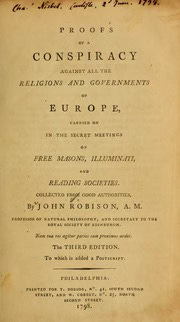
Only twenty years after the American Revolution, Americans were caught up in a widespread panic about the Illuminati, an enlightenment rationalist movement started by law professor Adam Weishaupt in 1776. In a bestselling 1797 book, Scottish scientist John Robison argued that the Illuminati were secretly responsible for the French Revolution, and were scheming to similarly destroy all religious establishments and topple every government in Europe. Robison framed Illumanism as a “libertine, anti-Christian movement, given to the corruption of women, the cultivation of sensual pleasures, and the violation of property rights,” Hofstadter explains. “Its members had plans for making a tea that caused abortion - a secret substance that ‘blinds or kills when spurted in the face,’ and a method that sounds like a stench bomb–a ‘method for filling a bedchamber with pestilential vapours.’” (78-9).
Ministers across New England took to their pulpits to warn against the dangers of the Illuminati; whenever they perceived that the United States government was straying too far from strict Christian values, they warned that the Antichrist-led Illuminati were to blame. In the nineteenth century, panics about the Masons and the Jesuits followed, with remarkable longevity: the baby-killing rumours I mentioned earlier gave way in time to allegations that the economic depression of 1893 was intentionally created by Catholics to destabilize America.2
Hofstadter, of course, was writing his essay in response to the emergent right wing that dominated American political life in the 1950s; the essay opens with an extended quotation from notorious anti-Communist senator Joseph McCarthy, who claimed that national troubles were the result of “a conspiracy of infamy so black that, when it is finally exposed, its principals shall be forever deserving of the maledictions of all honest men” (77). McCarthyism’s anti-Communist crusade led to the persecution and blacklisting of countless politicians, artists, and activists - whether or not they actually identified with Communist politics - in the name of rooting out the enemies of America.
Conspiratorial thinking, Hofstadter notes, appears in both the American political left and right at various points; all it requires is that adherents feel disenfranchised and identify an enemy to blame for their troubles. Nevertheless, it is more common among right-wing conservatives. “The modern right wing…” he writes (again, in 1964!) “feels dispossessed:”
America has been largely taken away from them and their kind, though they are determined to try to repossess it and to prevent the final destructive act of subversion. The old American virtues have already been eaten away by cosmopolitans and intellectuals; the old competitive capitalism has been gradually undermined by socialist and communist schemers; the old national security and independence have been destroyed by treasonous plots, having as their most powerful agents not merely outsiders and foreigners as of old but major statesmen who are at the very centers of American power. Their predecessors had discovered conspiracies; the modern radical right finds conspiracy to be betrayal from on high. (81)
Sound familiar? But we’ll get to that later.
Hofstadter outlines three more elements of the paranoid style that are important to mention. First of all, the enemy in this style of thinking is always a larger-than-life “model of malice, a kind of amoral superman–sinister, ubiquitous, powerful, cruel, sensual, luxury-loving” (85). Conspiracists take a perverse pleasure in vividly describing the sins of the enemy, which are usually violent and sexually deviant in nature.
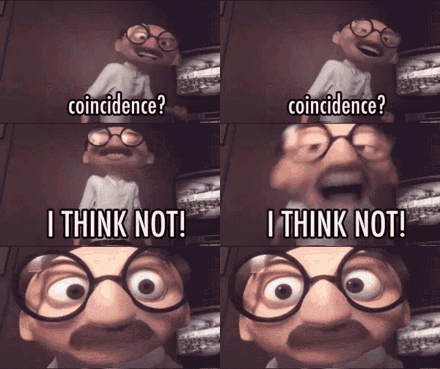
Secondly, adherents of the paranoid style see their enemies’ actions as “far more coherent than the real world.” They are remarkably consistent, organized, effective, and more thorough than any known movement or government: they manage enormous campaigns of sabotage and influence without widespread whistle-blowing or dissension. There are no coincidences and mistakes, only plans made and executed perfectly.
Finally - and this is so central that it seems almost too obvious to mention - the paranoid style is defined by fear. The world is a scary, corrupt place, full of sinister forces that must always be defended against lest they destroy all good things in the world.
“We are all sufferers from history,” Hofstadter concludes wryly, “but the paranoid is a double sufferer, since he is afflicted not only by the real world, with the rest of us, but by his fantasies as well” (86).
Extraordinarily Unlikely
I’m not going to spend much time on individual conspiracy theories in today’s Syllabus: both because I’ve covered some of them in the past, such as the Flat Earth movement or those surrounding the Satanic Panic, and because I don’t think that detailing or debunking individual conspiracies is a good use of my and my thoughtful readers’ time and attention.
I am not the audience for most conspiracy theories: I am both deeply skeptical and have a high level of trust in expertise; when I say I have done my own research, it generally involves academic articles or visits to archives.3 More than anything, I rely on the principle known as “Occam’s Razor”: attributed to the 14th-century philosopher William of Ockham, its basic premise is that - when presented with two competing hypotheses to explain the same problem, - you should prefer the hypothesis that requires the fewest assumptions. In other words, the simplest explanation is usually the most likely.
I recently came across an academic paper that uses an unusual tool to disprove conspiracy theories: math. In “On the Viability of Conspiratorial Beliefs,” David Robert Grimes presents a simple mathematical model that predicts the likelihood that conspirators will expose secrets as a conspiracy grows.
He establishes the parameters of his model by incorporating data from three real, known conspiracies that were exposed by whistleblowers, investigation, and incompetence: NSA surveillance of American citizens; the Tuskegee syphilis experiments, and the FBI forensics scandal.
Grimes then applies the model to four popular conspiracy theories that would all require the collaboration of more than 1000 people: that the moon landing was faked, that climate change is a hoax, that vaccines are designed to hurt and control people, and that doctors are concealing the cure for cancer. All of these conspiracies, he concludes, would require the perfect collaboration of so many people that it is almost mathematically impossible that they could be sustained for as long as conspiracists’ claim they have.
“One of the major motivations” of this research, Grimes notes in his conclusion, “is to help counter-act anti-science beliefs from gaining a foothold by quantifying how extraordinarily unlikely it is that a cohesive scientific fraud could take place on such massive scales.”
I appreciate Grimes’s efforts, though I wonder how persuasive his math and statistics would be to the average conspiracy theorist. Conspiracy theories are not appealing because they are logical or empirically sound; they appeal to us psychologically and narratively.
Despite my lofty skepticism, the truth is that conspiratorial thinking can be tempting, and no one is immune. If I’m being honest, I’m drawn towards one myself: that the meat industry secretly funds PETA to make veganism and vegetarianism look ridiculous.4
And certain conspiracies seem like harmless fun, like the various claims by cryptozoologists that Bigfoot or the Loch Ness Monster exist. Others may be kooky and embarrassing - Flat Earthers come to mind - but surely they’re ultimately harmless?
In a recent video, Hank Green talks about one of the most persistent and seemingly innocuous flavors of conspiracy-adjacent interest: the existence of aliens.
He begins the video with an admission: he really wants aliens to exist, and he wants them to contact us. That specific desire, however, is why he is so skeptical when claim after claim emerges that mysterious or unexplained phenomena are evidence of aliens.
“If we want something to happen, we will look for reasons it might be happening,” he says. There’s a reason why the iconic catch-phrase of the sci-fi show The X-Files, which featured investigations of aliens, conspiracies, and other paranormal phenomena, was “I want to believe.” The reason people so often attribute mysterious events to aliens, he says, is because people really want to believe in aliens. It would be cool.
The second problem, Hank argues, is that people are terrible at accepting the unknown, and so they look for explanations that will alleviate that discomfort. “But unexplained stuff is normal!” he says. “For 99.999% of human history, we had no idea what lightning was. The sky would just explode during storms. We still don’t precisely know how lightning works.” When the Ancient Greeks claimed that thunderstorms were caused by the anger of Zeus, their answer provided them with an explanation for the world around them, albeit a scary one. What it did not do, however, is get them any closer to a scientific understanding of electricity.
There is one quirk of alien conspiracy theories, however, that Hank finds particularly dangerous: the impossibility of disproving them by their own logics. Aliens are a useful explanation, he says, because they can explain anything weird. They don’t have to follow any rules: if they can break the laws of physics, use technology we can’t imagine, and otherwise defy the principles of scientific inquiry, then the lack of evidence for aliens can itself be used as evidence for aliens.
The problem with this train of thought is that “it is impervious to critique,” Hank concludes. “If you settle on an explanation that can explain anything, we stop looking for other explanations. You stop being able to hear people who disagree with you. And every time we have done that, every time, we stop learning.”
Ultimately, he says, it is because he is genuinely excited by the possibility of aliens that he demands such a high threshold of proof. “I don’t want to believe. I want to know.”
Who Is In Control?
If the biggest problem with conspiracy theories was that they encourage logical fallacies and a lack of sustained learning, then I would simply lump them in with Candy Crush and Jersey Shore as annoying but not terribly harmful. Unfortunately, as we have seen again and again in the last decade, conspiracy theories are immensely dangerous: for the people who believe them, for the subjects of those theories, and for democratic society as a whole.
My favorite deep dive into the psychology and ramifications of conspiracy theories is an epic feature-length documentary by the sardonic YouTuber “Contrapoints.” In her signature style, Contrapoints - aka Natalie Wynn - blends theatricality, humour, and rigorous research to explore what conspiracy theories have in common, and why they’re so damaging.
She opens by pointing to two recent inflection points where conspiracy theories led to documented harm: Edgar Maddison Welch’s threatening of patrons with an AR-15 at a Washington D.C. pizza parlour because he thought the restaurant was being used in a sex trafficking ring (aka “Pizzagate”), and Alex Jones’s repeated accusations that the parents and children traumatized by the Sandy Hook shooting were fraudulent “crisis actors.”
Both Welch and Jones have been emboldened - and to an extent their ideas have become mainstream - because one of America’s two major political parties has wholeheartedly embraced conspiracy theories. Donald Trump, after all, entered the political sphere by peddling birther conspiracies about Barack Obama back in 2011, and he frequently repeats bogus rumors (such as the racist claim that Haitian immigrants were eating neighborhood cats and dogs) and indulges in conspiratorial thinking about his political opponents.
Most famously, of course, Trump is a central figure in QAnon.
QAnon was an online messianic conspiracy cult whose core belief was that the world is ruled by a global elite of Satanic sex trafficking cannibals from whom The Children would be saved by reality-TV-star-turned-President Donald Trump, whose sacred mission was to declare martial law, end the adrenochrome harvest, and purge the Deep State pedovore cabal in a wave of mass executions called “The Storm.” This he would accomplish with the help of military intelligence insiders known as Q, who only communicated with the public via cryptic messages on a seedy racist image board called 8Kun, operated by a father-son team of American pornographers out of a hog farm in the Philippines.
I mean, when you sum it up like that it all sounds perfectly credible, doesn’t it?
Wynn isn’t just bashing Trump to bash Trump, however. Rather, her point is that when the highest positions of power and influence in American society are occupied by people who actively perpetuate and encourage conspiratorial thinking, then understanding conspiratorial thinking becomes inescapably important.
I don’t have time to recap the entire video - it’s both very in-depth and highly entertaining - but I do want to focus on one element of Wynn’s argument. Much like Hofstadter (who she cites), Wynn identifies three key elements of conspiracism: intentionalism, dualism, and symbolism. Of these three, I find intentionalism the most interesting.
Intentionalism is similar to Hofstadter’s theory of coherent organization: essentially, there are no coincidences, and everything happens for a reason. Wynn quotes philosopher Karl Popper: “The conspiracy theory of society comes from abandoning God and then asking: ‘Who is in his place?’”
Whether the answer is the Vatican, the Illuminati, the World Economic Forum, or the Lizard People, the actual named actors are less important than what they represent: explanations in a seemingly chaotic and unpredictable world. “It’s unnerving to think that no one is steering the ship,” she reflects. “So even if the deep state puppeteers are evil, it’s maybe reassuring to think that at least someone, somewhere is in control.”
Conspiracy theories give believers a rationale and a scapegoat for their suffering. They promise that everything happens for a reason, even if that reason is horrifying. And they cast their proponents as heroes, the protagonists of the story, blessed with exclusive and secret knowledge in a world of ignorance and lies.
False Flag
While everyone is susceptible to conspiratorial thinking, there are some pathways to conspiracy theories that are more well-trodden than others. As I learned first-hand as a kid, members of spiritual and religious groups - especially those trained to interpret world events through the lens of prophecy and think of themselves as the keepers of special truth - are particularly susceptible to conspiracy. This phenomenon goes far beyond Seventh-day Adventism or even Christianity; the book and podcast Conspirituality, for example, explores the overlap between New Age spirituality and right-wing conspiracies.
As we saw firsthand during the pandemic, wellness trends also frequently lead to conspiratorial thinking: anxieties around illness, social isolation, and a desire to avoid contamination led to anti-vaccine conspiracies, the Make America Healthy Again movement, and the return of preventable diseases like measles. In a 2021 episode of the podcast Maintenance Phase, QAnon scholar Mike Rothschild explores how innocent interest in yoga, healthy eating, and other wellness trends was intentionally weaponized to radicalize people into conspiratorial thinking.5
And of course, the relationship between social media algorithms and radicalization has been well-documented at this point: internet platforms like YouTube and Twitter create echo chambers for people and encourage them towards increasingly radical iterations of their existing beliefs. I’ve written before about the excellent podcast Rabbit Hole, which examines exactly how the architecture of technology encourages conspiratorial thinking.
All of these examples demonstrate how easily - and innocently - ordinary people can fall into conspiracy theory-type thinking. And, as Hofstadter established all the way back in 1964, leftists are not immune.
Last weekend, during the White House Correspondents’ Dinner, a lone gunman attempted to force his way in and assassinate Donald Trump. He was unsuccessful, not even making it past the security checkpoints separating dinner guests from the rest of the world.
In the hours following news of the assassination attempt, conspiracy theories spread like wildfire: online commentators examined video clips, images of politicians’ expressions, and public statements in minute detail, arguing that the assassination attempt was a false flag operation orchestrated by the Trump administration to gain sympathy and consolidate power.
These theories weren’t limited to a few fringe websites; they first showed up on my Instagram feed shared by friends from university and graduate school, and I encountered them in locations as unexpected and out-of-place as the subreddit r/catbongos, which usually features videos of people playfully drumming on their pets’ furry bodies.6
I was troubled by the false flag claims specifically because I found them so easy to believe. Trump has accused his political enemies of faking attacks on themselves, and in all three of his high-profile assassination attempts he has immediately weaponized the events to advance his agenda. Trump lies so prolifically and flagrantly that it doesn’t take a huge leap in logic to think he’d lie about this too.
Ultimately, however, I’m not convinced. As user u/octnoir puts it:
The reality is throughout history false flag attacks have been very few and far between. It is exceedingly common for fascist groups to just take advantage of random acts of violence or reprisal acts of violence or in this case control of the media to drive a narrative. That often happens anyways since fascists like to poke and prod until they get a reaction since it justifies their world view.
In turn [the] chaos and paranoia they spread not only aids fascist takeover since it is easy to justify authoritarianism under chaos, it also causes individuals to stress out further and further until eventually one snaps and decides to risk it all.
Occam’s Razor is right - what’s more likely? That an incompetent set of buffoons that can barely keep straight on the Epstein files are able to seamlessly smuggle in a false flag attack? Or that the economy is shit, society is fracturing, violence is increasingly normalized, everyone is traumatized, everything is chaos, and that someone stressed out of their minds decided to alleviate it with their own individual action?
I am concerned, however, at how Trump’s own conspiratorial logics are infecting the left. What does it say about us if we start to think and play by his rules? Where do we go from here?
I’m afraid I don’t have a neat explanation or a simple narrative that will tie everything together.
As Hank says, I don’t want to believe. I want to know.
And all I know for sure is that living in a world that doesn’t value shared authority, empirical evidence, or absolute truth is terrifying.
When it comes to conspiracy theories, what should I add to my syllabus?
I want to hear from you, whether it’s in the comments on this post or in emails to me directly at roschmansyllabus@substack.com!
These lurid accounts - and the moral panic surrounding Awful Disclosures - bear more than a little resemblance to the Satanic Panic initiated by Michelle Remembers 140 years later, which I wrote about back in 2024. Ironically, of course, in Michelle Remembers the heroes are all Catholic, and Michelle is rescued from the baby-killing Satanists by the Virgin Mary herself. Oddly enough, both Maria Monk and Michelle Smith were Canadian. Makes you wonder, doesn’t it, whether Canada is Up to Something…
These days, of course, most conspiracy theories boil down to garden-variety anti-Semitism. Adventists are refreshingly vintage in that regard.
I recently custom-ordered a baseball cap that simply says [citation needed]. Consider it unofficial Syllabus merch.
Seriously, PETA are so laughably awful that it’s hard to believe they’re doing anything meaningful to improve animal welfare.
No relation to those other Rothschilds, though he jokes it’s a hell of a conversation starter in conspiratorial spaces.
In this case, the Cat Bongos subreddit’s moderator used his control as “Supreme Leader” to pin a post with his version of the theory to the top of the page for 24 hours. Opinions among commenters were mixed as to whether they welcomed the anti-Trump discussion or were frustrated to see politics bleed into a silly and escapist corner of the internet. Incidentally, it was in the comments of a post about this subreddit on r/SubredditDrama that I discovered the aforementioned academic math paper.